



Real estate investors and homeowners share a common goal – they want to build wealth while keeping risk under control. In commercial real estate the sale‑leaseback has long been a tool for creating steady cash flow, but it is now becoming mainstream in residential investing. If you’re looking for passive income, fewer vacancies and a way to tap your equity without taking on new debt, a sale‑leaseback paired with a tax‑deferred 1031 exchange could be the answer. This guide explains how the strategy works and why partnering with Sell2Rent and Deferred can help you execute it.
What is a sale‑leaseback?
A sale‑leaseback is straightforward: a property owner sells their home to an investor and then stays in the house as a renter. Sources like Investopedia describe a leaseback (also called a sale‑leaseback) as a transaction where the owner sells an asset and then leases it back from the buyer, enabling the seller to unlock the capital tied up in the property while continuing to use it. Residential providers such as Truehold point out that this “sell and stay” option allows homeowners to turn home equity into cash without moving; the homeowner sells their property, signs a lease and continues living there, tapping their equity without taking on additional debt. Rent‑back agreements are typically short‑term, but sale‑leasebacks can run for a year or more and are sometimes called sell and stay, rent‑back or sale and rent back arrangements.
Why sellers choose a sale‑leaseback
Homeowners opt for a sale‑leaseback for the same reasons investors like them – liquidity and stability. Instead of borrowing against equity or taking out a reverse mortgage, a sale‑leaseback lets owners convert their asset into cash and then remain in a familiar home. Truehold notes that this type of agreement allows you to sell the home and continue living in it, using the equity to pay off debt, start a business or cover retirement expenses without incurring new debt. Additional benefits for sellers include:
- Immediate liquidity: You access the equity in your house right away, which you can use for investing, bills or major life events.
- Stay put: You remain in your home and neighbourhood, keeping children in the same schools and maintaining routines. Rocket Mortgage emphasises that rent‑back agreements let home sellers stay in their property and rent it from the buyer after closing.
- Lower expenses: Property taxes, insurance and major repairs shift to the new owner, relieving you of costly upkeep and freeing up more cash.
- Flexibility: Unlike reverse mortgages, sale‑leasebacks have no age restrictions or heavy paperwork requirements, and lease terms are negotiated up‑front to fit your needs.
Why real‑estate investors should pay attention
For investors seeking investment properties with immediate returns, sale‑leasebacks offer several advantages:
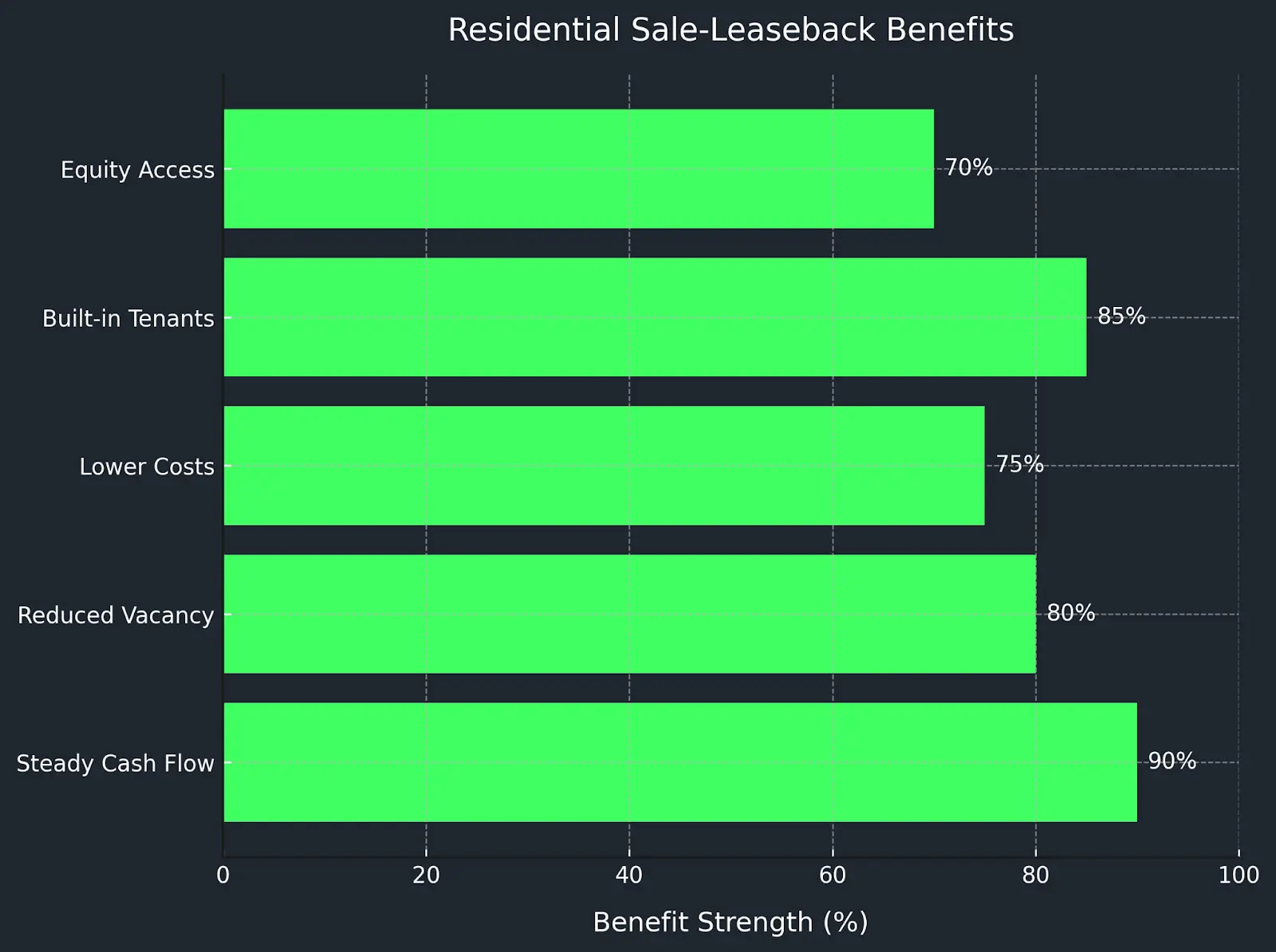
- Built‑in tenant & cash flow: You acquire a home below market value with a tenant in place. Rental payments begin at closing, so you generate cash flow from day one.
- Lower vacancy risk: Because the seller stays on, there are no marketing costs or months of vacancy. A steady tenant reduces one of the biggest risks in rental property investing.
- Minimal repairs: Sellers usually continue to maintain the home, and inspections performed before closing mean you have a clear picture of the property condition. There are no surprise renovations.
- Equity and income: You’re buying both a discounted asset and the rental income attached to it, making efficient use of capital.
- Passive investment: For first‑time real estate investors, sale‑leasebacks can be as passive as it gets. You avoid the headaches of finding tenants, renovating a property or handling frequent turnovers.
Smart risk management for sale‑leaseback investors
Every investment carries risk, but sale‑leasebacks provide tools to manage it intelligently. Here are a few strategies to keep in mind:
- Stable cash flow reduces vacancy risk. A tenant already occupies the home, so your rental income is predictable and vacancy gaps are minimal.
- Predictable lease terms. Lease agreements are negotiated during the sale, giving you certainty about rental rates and lease duration. This visibility is valuable when planning cash flow and financing.
- Transparent property condition. Pre‑closing inspections and tenant occupancy reduce the likelihood of hidden problems. Knowing the property’s condition helps you budget for future repairs.
- Efficient capital deployment. Acquiring an asset below market value with a tenant in place gives you both equity and income at closing, optimising your return on investment.
- Data‑driven decisions. Analyse neighbourhood trends, rent comparables and market fundamentals before investing. Tools like My Real Estate Analytics can help you evaluate deals and manage risk.
Pairing sale‑leasebacks with 1031 exchanges
Many sophisticated investors use sale‑leasebacks in tandem with a 1031 exchange to build wealth tax‑efficiently. Under U.S. tax law, a 1031 exchange allows investors to defer capital‑gains tax on the sale of one investment property by reinvesting the proceeds into another like‑kind property To qualify, the relinquished and replacement properties must be held for investment or business purposes and located in the United States By combining a sale‑leaseback (to secure a cash‑flowing asset) with a 1031 exchange (to defer capital gains), investors can potentially upgrade their portfolio while keeping more capital working for them.
Deferred makes this even easier. Deferred describes itself as “the No Fee way to 1031 exchange,” providing a trusted qualified intermediary with 100% 5‑star reviews. They hold your exchange funds in segregated accounts with FDIC insurance and share the interest earned. Working with Deferred allows investors to execute a compliant 1031 exchange seamlessly and securely, preserving more of their proceeds for the next investment by removing 1031 exchange fees.
How Sell2Rent and Deferred help you invest
Sell2Rent operates a property marketplace that sources off‑market residential sale‑leaseback deals across the United States. Investors can browse opportunities that already include tenants, evaluate potential returns and submit offers. Whether you’re looking for your first rental property or adding to an existing portfolio, Sell2Rent offers a pipeline of residential real estate investments designed for passive income.
As part of our collaboration, we’ve added quick links to help you get started:
Start investing now – view available sale‑leaseback deals and begin your real‑estate investing journey. https://bit.ly/4c1ZUBN
Explore properties – search the Sell2Rent marketplace for off‑market investment properties. https://bit.ly/3Qi141N
Learn about Deferred – discover how Deferred’s No Fee 1031 exchange can help you defer taxes and reinvest more capital. https://www.deferred.com/
The bigger picture
Residential real estate is evolving. With higher interest rates and affordability challenges, sale‑leasebacks are emerging as a win‑win strategy: homeowners access their equity without moving, and investors acquire income‑producing properties with built‑in tenants. When combined with a 1031 exchange, investors can defer capital gains tax and redeploy capital into additional opportunities investopedia.com. By partnering with Sell2Rent and Deferred, you gain access to a curated marketplace of sale‑leaseback opportunities and a trusted, no‑fee intermediary for your exchanges. That means more cash flow, less risk and smarter wealth‑building.
Ready to turn equity into opportunity?
Start investing today or explore properties to discover how sale‑leasebacks can enhance your real‑estate portfolio.
Alex Arguelles is the CEO and Co-Founder of Sell2Rent and a recognized pioneer in the sale-leaseback space. He previously co-founded a management firm that he scaled to 175+ employees and 15,000 apartments, proving his ability to manage large-scale real estate operations. As host of The Alex Show, he shares high-level acquisition strategies and market insights with the investor community. Alex’s extensive track record in scaling disruptive companies makes him a premier authority for readers navigating modern residential investment.
Oops! Something went wrong while submitting the form.
Thank you! Your submission has been received!
Oops! Something went wrong while submitting the form.
Subscribe to the Real Estate Digest. Weekly newsletter.